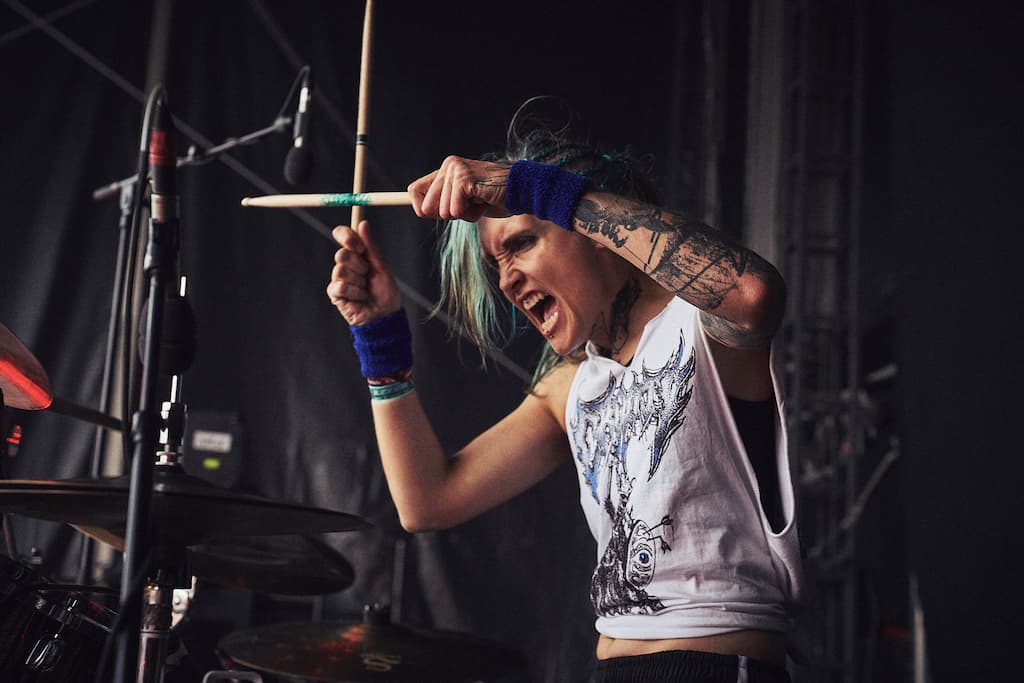
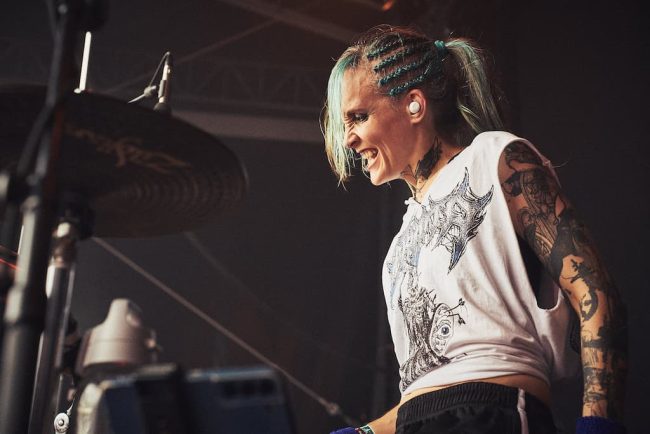
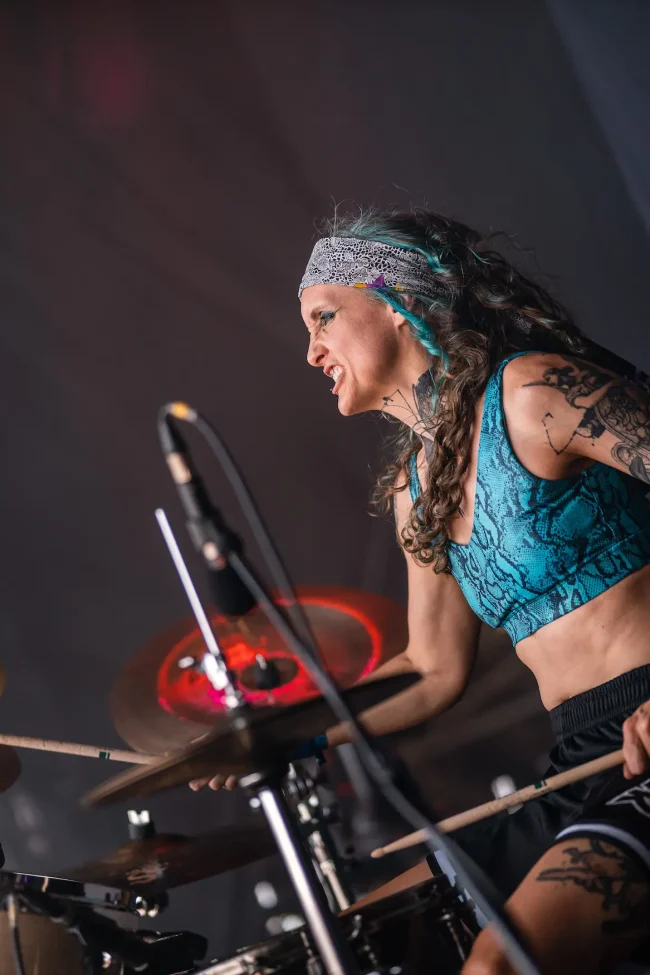
Fifth entry of Drummer of the Week. This time we spoke with Bea Heartbeat, drummer of Vulvarine. From a samba percussion workshop to a double bass drum setup that makes the band “heavier than it might seem at first listen,” with a hospital trip mid-recording-session and a broken bass drum held overhead mid-show so the crowd could see exactly what happened.
How she ended up behind the kit: a samba workshop that blew her mind
Bea’s origin story has nothing to do with metal — it starts in 90s world music:
“It was the early 90s and my Mom was deep into world music. One weekend she took me to a Samba Percussion Workshop. We ended up performing on stage for a live audience. The soundscape of ~25 people playing only drums and percussion instruments just blew my mind. And when people in the audience started to stand up and dance, I knew that this is where I wanted to be. At 15, I finally got my first drumkit and immediately joined a band.”
Influences: no single name, just a role that fascinated her
Unlike other entries in the series, Bea doesn’t point to one drummer who made her say “I want to do that”:
“There was never one particular style or person that ‘made me’ want to play the drums, it was much more the role of the drummer or percussionist in general that fascinated me. As a teen I had a crush on Travis Barker, of course. And when I first got into metal there were Dave Lombardo and Lars Ulrich who were big role models back in the day and also an inspiration for me.”
On Lars Ulrich, and on who’s underrated today, her answer has a particular angle:
“Lars took a lot of shit later on and for sure there are better drummers out there. But he still shaped an era of metal and a whole generation of drummers. In that respect, you might consider him underrated.”
Her role in Vulvarine: “a badass double bass”
Asked what she brings that isn’t obvious on first listen, Bea checked with her bandmates before answering:
“I asked the girls, they said ‘a badass double bass’. Our music is heavier than it might seem at first listen because of my metal-inspired double-bass drumming.”
The setup: a hybrid Bone kit with art by a Slovenian tattoo artist, and a “Frankenstein” cymbal situation
The full gear rundown, with an unconventional kit:
Kit: Bone, a carbon-maple hybrid, nickel black hardware, with a custom finish wrap designed by Slovenian tattoo artist Tavci. 10″×7″ and 12″×8″ toms, 16″×16″ floor tom, 22″×18″ bass drum.
Snare: a 14″ Mapex Black Panther she’s played for many years.
Cymbals: she describes it herself as a “Frankenstein sort of situation,” because she plays whatever works depending on the occasion. Currently two Xist Brilliant crashes by Istanbul Agop (16″ + 18″ typically; 18″ + 20″ on big stages, like the Headbangers stage at Wacken, where she played in 2025). 14″ hi-hats and a 20″ ride from the Zildjian S Dark series. A 20″ Zultan Rock Beat china. And, of course, the obligatory cowbell.
Pedal: her newest addition is a Tama Dyna Sync DB pedal, an upgrade from the Iron Cobra she played for many years.
The piece she’d never trade: honestly, none of it
Unlike the rest of the series, Bea answers this question with a different philosophy entirely:
“Hm… that’s a good question. I try not to get too attached to things, as a general rule in life. I tend to break stuff. Joke aside, I am happy with my current setup but I’m always ready to try new things, adapt and change. I wouldn’t want to play with fewer than three toms though, because to me more toms equal more fun.”
“My first drumkit was a Pearl export series, which I got second hand from a friend. I was just a kid, and so excited about being in a band and hanging out with the older metal guys.”
Her advice to that younger version of herself:
“I’d probably tell her: You’re onto something great. Believe in yourself, set goals and practice. Put in the work and it’ll pay off in the end.”
The tuning trick: knock the rim, not the head
An unusual and very practical trick for tuning in noisy environments:
“Not really. But something that I find very useful if I need to tune in a noisy environment is knocking on the rim of the drum with a drumkey, instead of tapping the head. You can still hear the differences in pitch but the metal-on-metal sound usually cuts through the stage noise way better if you have your ears close to the drum.”
Worst live situation: the broken bass drum she lifted overhead
This is, without a doubt, one of the best stories in the series so far — not just for what happened, but for how she handled it:
“Well, there are many glitches I could tell you about. Not long ago, four songs into our set, my bass drum head broke. I finished the song without bass drum, which was very painful to me. After the song I got up, lifted the bass drum over my head and showed the audience the broken drum head. Fortunately, I got a replacement moments later — shoutout to Lukas from Igel vs Shark.”
And the reflection that follows is, on its own, a statement of principle about playing live:
“Thinking about it now… even though it was a super stressful moment, I didn’t try to hide anything, but let the audience take part in what was happening on stage. And they seemed to enjoy it, judging by their cheers and applause. Playing live after all is less about perfection and more about spontaneity, fun and creating memories together.”
The story her friends keep bringing up: a purple finger and a hospital trip
“I try not to dwell on the past, but my friends keep bringing up this story: I had to go to the hospital once in the middle of a recording session because I hit my finger hard against the rim of a drum. The whole finger turned into a very dark purple. Luckily, I got to keep the finger. And I was even able to finish the session the next day.”
Recording: the lesson of the first song, unprepared and hungover
On which song was hardest to record, Bea’s answer doubles as a confession most musicians will recognize:
“Well, the first one I ever recorded for Vulvarine. Coming from metal, I thought recording rock songs was gonna be a walk in the park for me. I showed up at the studio ill-prepared and on top of that hungover. Took me at least double the time that was initially planned. Since then I try to prepare for studio sessions as good as I can – it saves everyone time and nerves, including my own. And it’s just much more fun this way.”
Why drummers are the least recognized: a different take from the rest of the series
Unlike previous answers in this series, Bea doesn’t fully accept the premise of the question:
“I generally don’t feel underappreciated. Maybe we are less visible on stage, that’s true… but drummers know that they are the beating hearts of every band out there.”
Three albums, one piece of advice, and double pedal vs. double bass drum
Three albums every metalhead should study for the drumming, with an important caveat before naming them:
“I wouldn’t dare to say every metal drummer HAS to study them, but I find those very inspiring: Metallica – …And Justice for All (1988); Mastodon – Leviathan (2004); Lamb of God – Sacrament (2006).”
Advice for someone starting out on metal drums:
“Have as much fun as possible with your instrument and see where the journey takes you.”
Double pedal or double bass drum? A pragmatic answer, with room left for spectacle:
“Playing a single bass drum with a good DB pedal is definitely the easiest and safest way to go – think of small stages, small drum risers, tuning, mic issues etc. Having said that, I wouldn’t mind playing two bassdrums in bigger venues and on festivals. It just looks badass.”
FAQ: Bea Heartbeat (Vulvarine)
What band does Bea play in?
She’s the drummer of Vulvarine, a band that played the Headbangers stage at Wacken in 2025.
What drum kit does Bea play?
A hybrid carbon-maple Bone kit with a custom finish by tattoo artist Tavci (10″ and 12″ toms, 16″ floor tom, 22″ bass drum), a 14″ Mapex Black Panther snare, Istanbul Agop and Zildjian S Dark cymbals, a Zultan Rock Beat china, and a Tama Dyna Sync DB pedal.
What’s Bea’s most memorable live story?
Her bass drum head broke four songs into a set; she finished the song without it, then lifted the bass drum overhead to show the crowd the broken head before getting a replacement moments later.
What albums does Bea recommend for studying metal drumming?
Metallica’s …And Justice for All, Mastodon’s Leviathan, and Lamb of God’s Sacrament.
We use cookies on our website to give you the most relevant experience by remembering your preferences and repeat visits. By clicking “Accept”, you consent to the use of ALL the cookies.
This website uses cookies to improve your experience while you navigate through the website. Out of these, the cookies that are categorized as necessary are stored on your browser as they are essential for the working of basic functionalities of the website. We also use third-party cookies that help us analyze and understand how you use this website. These cookies will be stored in your browser only with your consent. You also have the option to opt-out of these cookies. But opting out of some of these cookies may affect your browsing experience.
Necessary cookies are absolutely essential for the website to function properly. These cookies ensure basic functionalities and security features of the website, anonymously.
Cookie
Duración
Descripción
cookielawinfo-checkbox-analytics
11 months
This cookie is set by GDPR Cookie Consent plugin. The cookie is used to store the user consent for the cookies in the category "Analytics".
cookielawinfo-checkbox-functional
11 months
The cookie is set by GDPR cookie consent to record the user consent for the cookies in the category "Functional".
cookielawinfo-checkbox-necessary
11 months
This cookie is set by GDPR Cookie Consent plugin. The cookies is used to store the user consent for the cookies in the category "Necessary".
cookielawinfo-checkbox-others
11 months
This cookie is set by GDPR Cookie Consent plugin. The cookie is used to store the user consent for the cookies in the category "Other.
cookielawinfo-checkbox-performance
11 months
This cookie is set by GDPR Cookie Consent plugin. The cookie is used to store the user consent for the cookies in the category "Performance".
viewed_cookie_policy
11 months
The cookie is set by the GDPR Cookie Consent plugin and is used to store whether or not user has consented to the use of cookies. It does not store any personal data.
Functional cookies help to perform certain functionalities like sharing the content of the website on social media platforms, collect feedbacks, and other third-party features.
Performance cookies are used to understand and analyze the key performance indexes of the website which helps in delivering a better user experience for the visitors.
Analytical cookies are used to understand how visitors interact with the website. These cookies help provide information on metrics the number of visitors, bounce rate, traffic source, etc.
Advertisement cookies are used to provide visitors with relevant ads and marketing campaigns. These cookies track visitors across websites and collect information to provide customized ads.