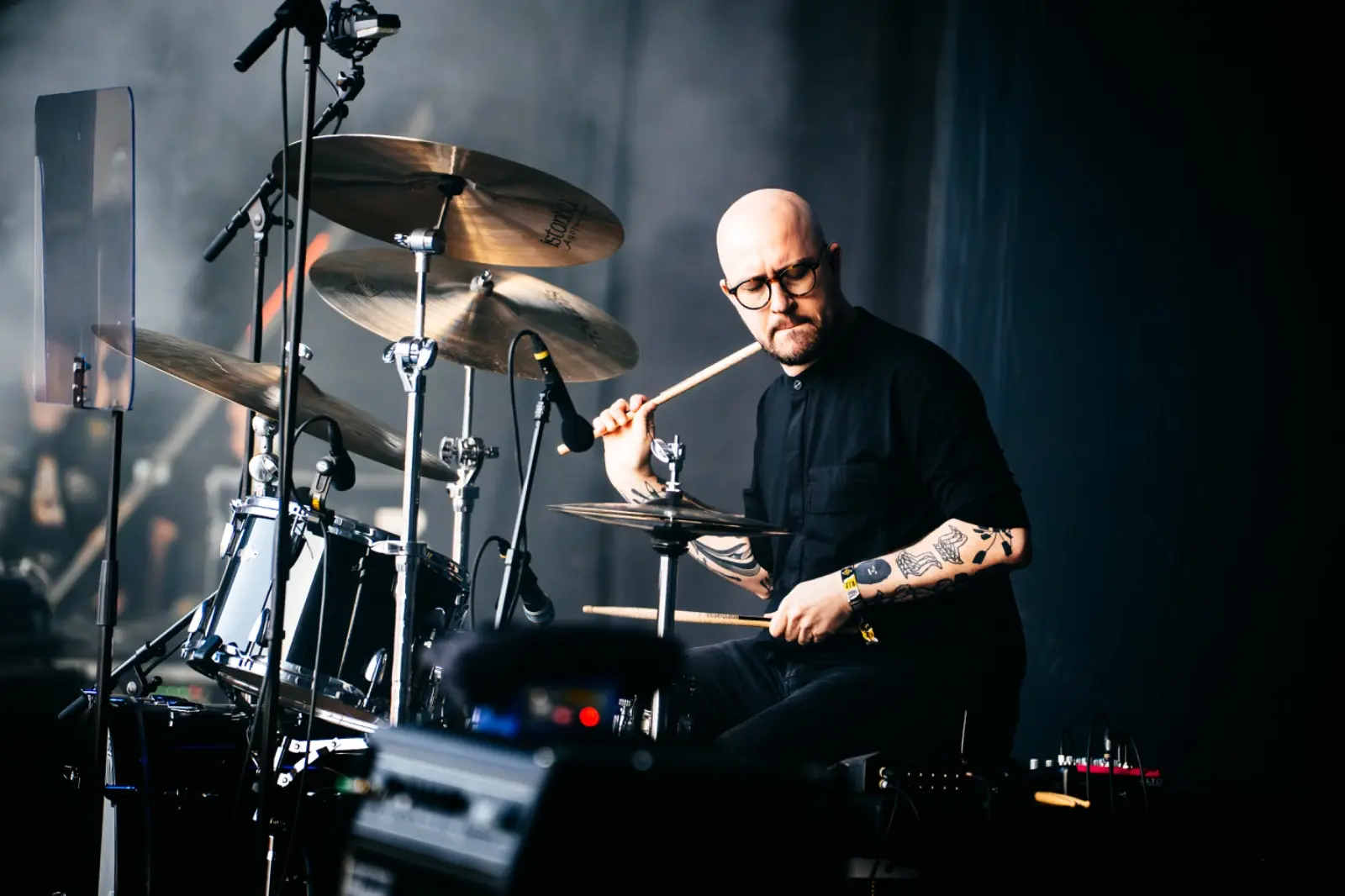
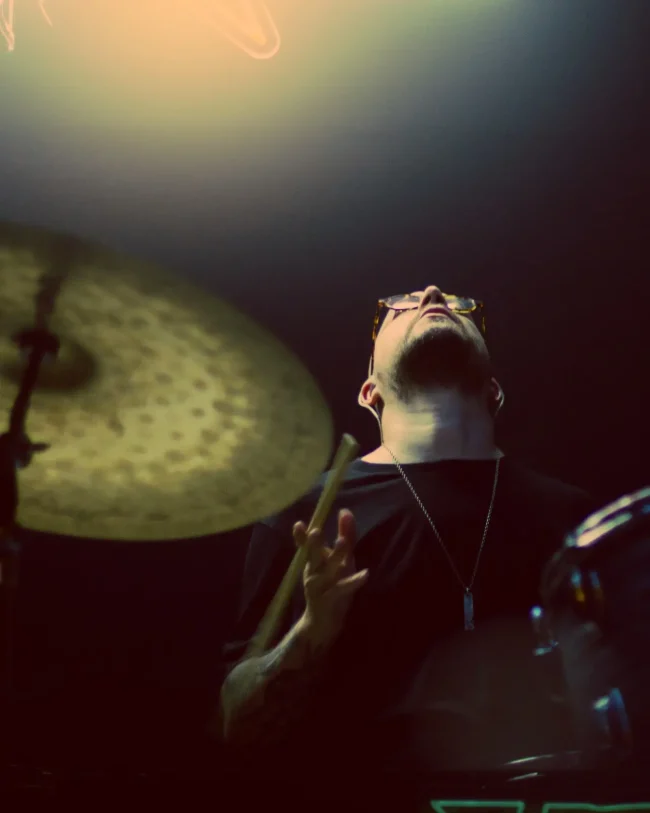
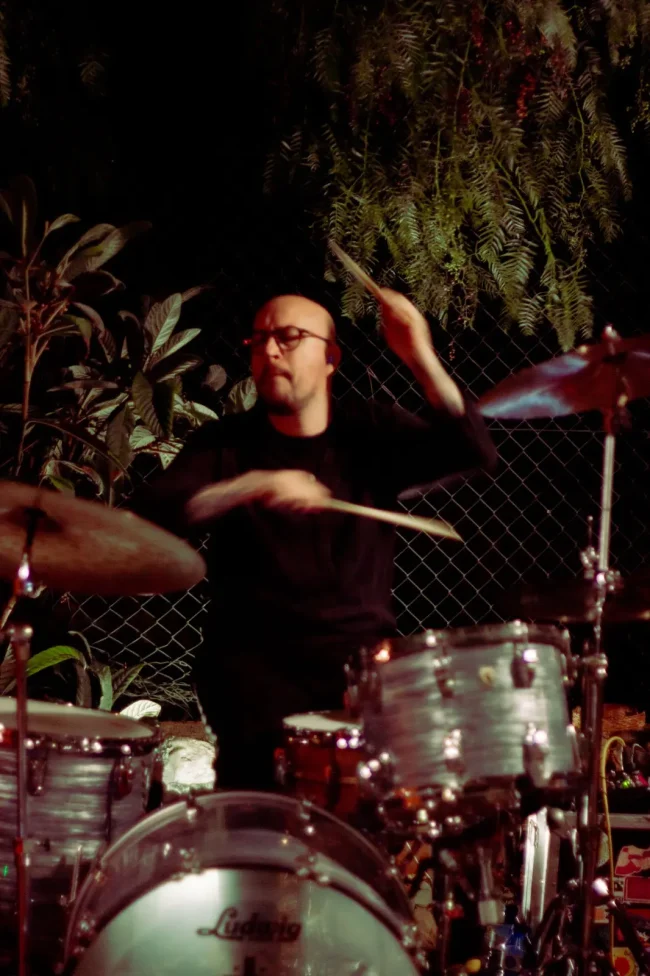
New series, first entry. Drummer of the Week is Metal Addiction’s new space dedicated to drummers on the scene — the instrument that, as comes up more than once in this first entry, almost never gets the recognition it deserves. We’re starting with Jaime Díaz Otero Núñez, a self-taught drummer for the past twenty years. He splits his scarce free time playing live with Myrkur and is part of the bands Santacreu, Intraether, Safata de Pórex and Lys Morke — plus a project that, for now, remains secret.
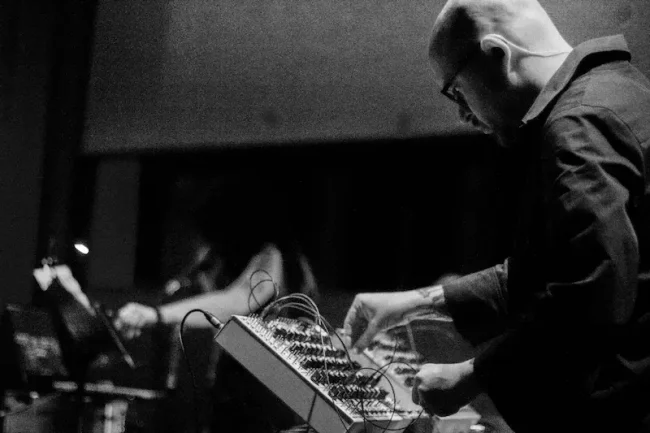
A progressive metal fan since his youth, Jaime has recorded and toured internationally with several of these projects, which span genres as different as black metal, doom, electronica and punk. His main instrument is drums, but for years he’s also been experimenting with synthesizers and drum machines, exploring a different side of extreme music where he doesn’t need a pair of sticks to make an audience’s eardrums shake.
A stripped-down but big-sized setup, a monitor disaster solved entirely by ear and metronome, and a reasoned defense of the click track. Let’s get into it.
How he ended up behind the kit: his brother’s Bic pens
Jaime’s origin story has a family angle and a conscious rejection of the “classical” path:
“My older brother used to do air drumming in his room with Bic pens, and I think that’s what got me noticing that instrument. Both him and my sister played more classical instruments like piano or oboe, but honestly those never interested me. So drums were always my first choice.”
Jaime Díaz Otero Nuñez
Influences: Lars Ulrich, the divisive album that changed his life, and a Cult of Luna name
Asked which drummer made him say “I want to do that,” Jaime doesn’t dodge an opinion he knows is controversial:
“Lars Ulrich was the first one who obsessed me and made me think I had to play drums. I’ll probably get hate mail for saying this, but Metallica’s Load specifically was one of those albums that changed my life. It’s easy to criticize both Lars and Metallica, but they’re a defining entity in metal and everyone in this world owes them a lot.”
On who’s underrated today, his answer points to a figure interesting precisely for moving between two very different scenes:
“There are plenty of underrated drummers; today I think Thomas Hedlund of Cult of Luna doesn’t get talked about enough. He has incredible feel and punch and is the heart of a band where percussion plays a huge role. Interestingly, he also plays in Phoenix, a very successful French alternative rock band, where he hits just as hard but in a ‘slightly’ different context.”
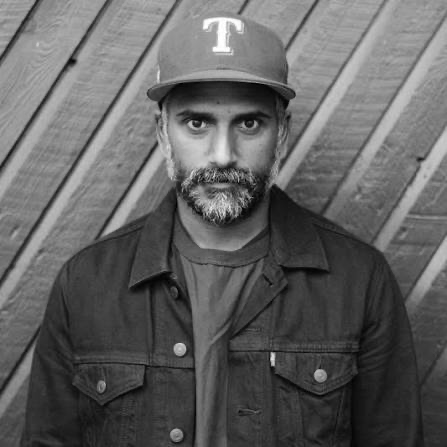
Thomas Hedlund de Cult of Luna
His role in the band: “the dad of the group”
Asked what he brings that isn’t obvious on first listen, Jaime describes a role that has nothing to do with technique:
“In pretty much all my bands I end up playing the role of the dad. It’s something people don’t hear, but it comes naturally to me to look after the rest of the group, handle logistics, and worry about making sure the details are always sorted. It’s the kind of thing the audience never notices, but an organized, calm band always plays better!”
The setup: big sizes, a stripped-down kit, and a Moog that almost stole his heart
Jaime has an unusual philosophy for a metal drummer’s setup: simplify rather than accumulate.
“I’ve used the same setup for several years now. There have been times I ran more toms and cymbals, but over time I’ve tended to simplify, partly because it’s practical to travel with a smaller kit, and partly because it’s more challenging to develop technique and work on your sound when you’re using fewer elements. What is pretty characteristic is that I run very large sizes, mainly because that’s the kind of sound I like, and because it’s easier to make a big kit sound ‘small’ than the other way around.”
The full gear rundown:
Kit: Ludwig Classic Maple — 24×18 bass drum, 14×10 tom, 18×16 floor tom.
Snares: mainly a Ludwig Copper Phonic 14×6.5; depending on the project, also a Sonor Protean 14×5.25.
Double pedal: used a Pearl Eliminator for almost 20 years; retired it last year for a Tama Iron Cobra.
Cymbals: 24″ Zildjian K Light Ride, 22″ Zildjian Crash of Doom, 20″ Istanbul Dark Traditional Crash, 14″ Istanbul Mehmet 61st Anniversary Vintage hi-hat.
Electronics (for projects that need them): a Roland SPD-SX pad for samples, backing tracks and MIDI; drum machines from Perkons (Erica Synths), Pulsar-23 (SOMA) and Nord Drum 2; and the Moog Grandmother synthesizer.
On that last one, a confession you don’t usually get in a drum interview:
“That last one might actually be my favorite instrument in the world, and if I ever stop playing acoustic drums, it’ll be its fault.”
And the one irreplaceable piece of his acoustic kit:
“If I had to pick one irreplaceable thing from my traditional drum set, I’d say it’s the Zildjian K Light Ride. It’s a versatile cymbal with a fantastic sound; I’ve used it for years and I can’t picture playing with anything else.”
His first kit: a Pearl Export EX, and the trauma of opening for Cult of Luna
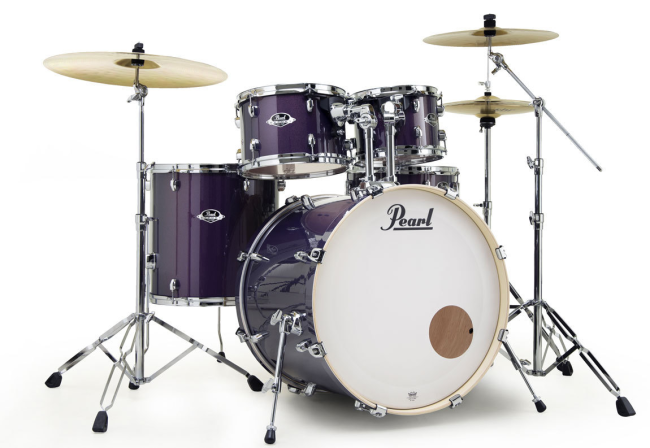
“It was a Pearl Export EX, basically the only kit the shop in my town had at the time. I used it until I opened for Cult of Luna with a band I had, and I was traumatized by how it sounded next to the two kits they brought — it sounded like a toy next to theirs!”
And the advice, with a touch of self-criticism:
“If I could tell that drummer something, I’d probably recommend studying some technique; things would probably have been easier, I’d have progressed faster, and I’d have saved myself an injury or two…”
Pearl Export Series EXX705NBR C737 Pearl Nebula
The sound trick that’s really just common sense: ergonomics
Rather than a tuning trick, Jaime points to something more physical and less talked about:
“Everything affects the sound, but I think the trick that’s helped me most has always been focusing on ergonomics. Drumming is a very physical instrument and has a direct impact on a musician’s joints. A lot of fast, repeated movements in a bad position is a recipe for injury. It’s really more common sense than a trick, but I think investing time in having good posture, making sure every piece of the kit is properly oriented, having the cymbals within reach without having to lean your body toward them… all of that is basic stuff that makes the technique easier, and that lets you focus on what matters, which is playing well and getting a good sound out of the instrument.”
Worst live situation: deafening white noise and a tech who couldn’t see him
This story is probably the tensest one in the series so far — and the way out of it is pure craft:
“Soundcheck, everything’s fine, the mix in my monitors is clear, I can hear everything perfectly and everyone’s happy and excited for the show. Half an hour later we go up to play and my monitor is only putting out deafening white noise. The sound engineer is standing behind a column and can’t see me. I had to pull the monitor cable, kill it, and turn the metronome volume up as loud as it would go. From there, I played the entire show without being able to hear a single note from the rest of the instruments.”
And the ending, with well-earned pride:
“I’m particularly proud of that day because in the end all those hours of rehearsal and metronome practice paid off. I didn’t enjoy the show at all, but at least it came out okay!”
The story he always ends up telling: the pasta that couldn’t get cold
Of all the touring stories collected so far in this series, this one is the most absurd — and the most food-related:
“Probably the funniest one was an Italian promoter who did everything possible to ration the food he gave us on show day to the absolute minimum. One plate of fries for 18 people. Twelve half-liter water bottles for everyone, for the whole day, in 30-degree heat. And then, against all odds, right when my band’s soundcheck was underway, he came to ask us to stop immediately: it was dinner time and the food was being served, and it was unthinkable that we wouldn’t eat dinner with everyone else because the pasta would go cold. He’d had us rationing food all day, and then the guy’s worried about the pasta being al dente!”
The ending, at least, is a kind one:
“In the end he let us finish the soundcheck and we became friends. And the pasta was good, even though we ate it late :)”
Recording: “the hardest song is always the one you haven’t recorded yet”
Asked which song was hardest to record, Jaime gives an answer that works almost as a philosophy of studio work:
“Recording sessions are a bit like exams: everything seems impossibly hard until you actually do it, and then, once you’ve passed, it feels like it was easy all along. I’d say the hardest song is always whichever one is still left to record. This year I’m actually going into the studio with Santacreu, and there are a couple of songs we’ve written that I can already tell are going to make me sweat, structurally and in terms of arrangement.”
Looking back, though, one name stands out:
“If I have to look to the past, I’d say Mr. Pan by Obsidian Kingdom is the song that’s given me the most trouble in the studio, ever. It has rhythmic patterns that, without being devilishly hard, do require a lot of care and attention to make them flow.”
(Editorial note: Obsidian Kingdom is a former band of Jaime’s — he’s no longer part of the lineup. The quote is kept because it’s a direct reference to his own studio experience, with the necessary context added.)
Why drummers are the least recognized: invisible, yet responsible for everything
Jaime’s answer is, along with Mati’s in a future entry of this series, one of the most complete takes on the very problem this section exists to explore:
“We’re at the back of the stage, the lights never point at us (unless you’re Mike Portnoy), and we’re hidden behind the kit. We’re basically invisible, and at the same time we’re usually the ones responsible for keeping time for the whole show, running the metronomes, the sequences, sometimes even the projections. A single mistake can throw an entire song off, or force you to restart it, so it tends to be a position of a lot of responsibility. That’s something the audience usually isn’t aware of.”
Three albums, one piece of advice, and a reasoned defense of programmed drums
Three albums every metalhead should study for the drumming, each with an extended case:
“I’d go as far as to say Opeth’s Ghost Reveries is one of those bibles of metal drumming, a full lesson in musicality, power, precision and creativity. The track Ghost of Perdition alone is basically an instruction manual for an entire genre. Martin Axenrot always seemed like the more complete drummer to me, but Martín López’s personality and creativity make him the OG.”
“At the other extreme I’d put Cult of Luna’s Vertikal, where the key is in the force, the repetition and the nuance. In my opinion, it’s much harder to convincingly write and perform something that minimal than something ultra-technical […] Besides I, The Weapon […] I think Mute, Departure and In Awe Of are great showcases of Thomas Hedlund’s genius.”
“A third album I find essential for its drumming would be Foscor’s Les Irreals Visions […] I heard it and fell in love at first listen, and a lot of the credit goes to Jordi Farré, who recorded that album and is these days the drummer for The Ocean or Crippled Black Phoenix, among others.”
Advice for someone starting out on metal drums:
“Use a metronome, at the very least when you practice, but ideally live too. It depends a lot on the subgenre, but in general metal demands precision and consistency, and, even though it sounds counterintuitive, playing with a metronome frees you up enormously while also helping you improve very quickly. My biggest jump in level as a player was, without a doubt, when I started using one.”
On programmed drums in modern metal — an extra question Jaime answered that expands the series’ standard questionnaire:
“As someone who uses samples and plays in projects with a lot of triggered elements, I understand it and I respect it. Every project has its own conditions, and it’s getting more and more expensive to record and tour, and in that sense drums are the instrument that generates the most cost. Obviously I prefer real drums, and the less editing and programming, the better.”
FAQ: Jaime Díaz Otero Núñez
What band does Jaime play in?
Jaime Díaz Otero Núñez plays in Santacreu, Intraether, Safata de Pórex and Lys Morke, is the live/touring drummer for Myrkur, and is also involved in a project that hasn’t been revealed yet. He was previously a member of Obsidian Kingdom.
Is he a self-taught drummer?
Yes, he’s been a self-taught drummer for twenty years, and has recorded and toured internationally with several of his projects.
What drum kit does Jaime play?
A Ludwig Classic Maple (24×18 bass drum, 14×10 tom, 18×16 floor tom), Ludwig Copper Phonic and Sonor Protean snares, a Tama Iron Cobra double pedal, and Zildjian and Istanbul cymbals, with the 24″ Zildjian K Light Ride as his irreplaceable piece.
What’s Jaime’s most memorable live story?
A show where his monitor put out nothing but deafening white noise and the sound tech couldn’t see him from his position; he ended up playing the entire show guided only by the metronome, unable to hear the rest of the band.
What albums does Jaime recommend for studying metal drumming?
Opeth’s Ghost Reveries, Cult of Luna’s Vertikal, and Foscor’s Les Irreals Visions.
We use cookies on our website to give you the most relevant experience by remembering your preferences and repeat visits. By clicking “Accept”, you consent to the use of ALL the cookies.
This website uses cookies to improve your experience while you navigate through the website. Out of these, the cookies that are categorized as necessary are stored on your browser as they are essential for the working of basic functionalities of the website. We also use third-party cookies that help us analyze and understand how you use this website. These cookies will be stored in your browser only with your consent. You also have the option to opt-out of these cookies. But opting out of some of these cookies may affect your browsing experience.
Necessary cookies are absolutely essential for the website to function properly. These cookies ensure basic functionalities and security features of the website, anonymously.
Cookie
Duración
Descripción
cookielawinfo-checkbox-analytics
11 months
This cookie is set by GDPR Cookie Consent plugin. The cookie is used to store the user consent for the cookies in the category "Analytics".
cookielawinfo-checkbox-functional
11 months
The cookie is set by GDPR cookie consent to record the user consent for the cookies in the category "Functional".
cookielawinfo-checkbox-necessary
11 months
This cookie is set by GDPR Cookie Consent plugin. The cookies is used to store the user consent for the cookies in the category "Necessary".
cookielawinfo-checkbox-others
11 months
This cookie is set by GDPR Cookie Consent plugin. The cookie is used to store the user consent for the cookies in the category "Other.
cookielawinfo-checkbox-performance
11 months
This cookie is set by GDPR Cookie Consent plugin. The cookie is used to store the user consent for the cookies in the category "Performance".
viewed_cookie_policy
11 months
The cookie is set by the GDPR Cookie Consent plugin and is used to store whether or not user has consented to the use of cookies. It does not store any personal data.
Functional cookies help to perform certain functionalities like sharing the content of the website on social media platforms, collect feedbacks, and other third-party features.
Performance cookies are used to understand and analyze the key performance indexes of the website which helps in delivering a better user experience for the visitors.
Analytical cookies are used to understand how visitors interact with the website. These cookies help provide information on metrics the number of visitors, bounce rate, traffic source, etc.
Advertisement cookies are used to provide visitors with relevant ads and marketing campaigns. These cookies track visitors across websites and collect information to provide customized ads.